Stationery vs Stationary: What’s the Difference?
If you’ve ever paused while typing stationery and wondered whether it should be stationary instead, you’re not alone. This pair of words is one of the most commonly confused in English, frequently discussed in forums, writing communities, and Reddit threads.
Despite sounding identical, stationery and stationary have very different meanings. Mixing them up is easy, but understanding where they come from and how they’re used makes the difference much clearer.
This guide explains what each word means, where they come from, why they’re confused so often, and simple ways to remember which is which.
Stationery vs Stationary: The Short Answer
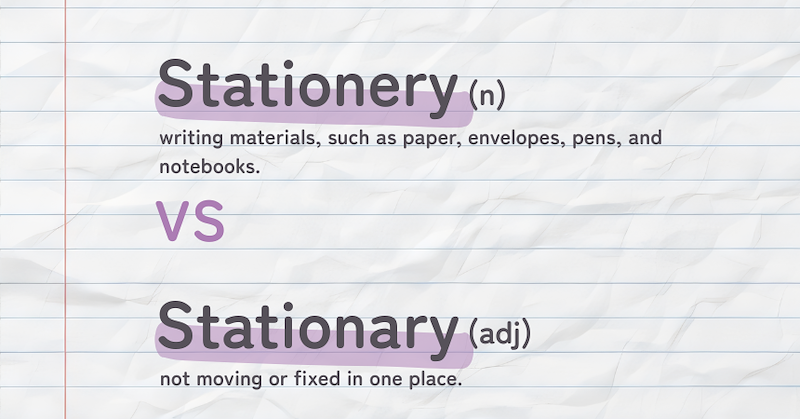
- Stationery refers to writing materials, such as paper, envelopes, pens, and notebooks.
- Stationary means not moving or fixed in one place.
They are pronounced the same, but their meanings and usage are completely different.
What Does “Stationery” Mean?
Stationery is a noun that refers to materials used for writing or correspondence.

Examples include:
- Paper
- Envelopes
- Notebooks
- Letter sets
- Writing accessories
Example sentence:
She bought new stationery for journaling.
The word is most commonly used in contexts related to writing, education, offices, and creative work.
What Does “Stationary” Mean?

Stationary is an adjective that describes something that is not moving or staying in one place.
It is often used in physical, technical, or descriptive contexts.
Example sentences:
- The car remained stationary at the traffic light.
- The bike was stationary against the wall.
Stationary is never related to writing or paper goods.
Why Do People Confuse Stationery and Stationary?
There are a few reasons this confusion is so widespread:
1. They are homophones
Both words are pronounced exactly the same in modern English.
2. They differ by only one letter
The only visible difference is -ery vs -ary, which is easy to miss when typing quickly.
3. Spellcheck doesn’t always catch it
Both words are spelled correctly, so automated tools may not flag the mistake.
4. Stationery is more niche
“Stationary” is used more broadly in everyday language, while “stationery” is tied to a specific category.
Because of this, even native English speakers frequently mix them up.
The History and Roots of the Words
Understanding where these words come from makes the difference easier to remember.
The Origin of “Stationery”
Stationery comes from the Middle English word stationer.
In medieval Europe, a stationer was a bookseller or scribe who operated from a fixed station or stall, often near universities. Over time, the term came to refer not to the person, but to the materials they sold.
So although stationery is related to writing, its root actually connects back to places of trade, not movement.
The Origin of “Stationary”
Stationary comes from the Latin word stationarius, meaning “standing still” or “fixed.”
It evolved through Old French and Middle English to describe things that do not move.
This meaning has remained consistent over time and is still used in physics, mechanics, and everyday descriptions.
How to Remember the Difference
Here are a few simple memory tips that many writers find helpful:
Tip 1: Look at the “E” in Stationery

Stationery has an “e”, like envelope, email, pen or epistle.
All are related to writing or communication.
Tip 2: Think of “A” as “At Rest”

Stationary has an “a”, which you can associate with at rest or anchored.
Tip 3: Ask a Simple Question
Before choosing the word, ask:
- Is this about paper or writing? → stationery
- Is this about not moving? → stationary
Common Mistakes and Correct Usage
- Incorrect: I bought some beautiful stationary for my desk.
- Correct: I bought some beautiful stationery for my desk.
- Incorrect: The train was stationery for five minutes.
- Correct: The train was stationary for five minutes.
These small errors are easy to make, but once you notice them, they become easier to avoid.
Why This Distinction Still Matters
Even though language evolves, this distinction remains important for clarity. Using the wrong word can:
- Change the meaning of a sentence
- Distract readers
- Reduce credibility in professional or educational writing

Because stationery is a specific category with its own history and cultural relevance, preserving the correct spelling helps maintain precision in communication.
A Final Thought
Stationery and stationary may sound the same, but they live in very different worlds. One belongs to writing, creativity, and correspondence. The other belongs to stillness and lack of movement.
Once you understand their meanings and origins, the difference becomes much easier to remember—and you may start noticing the mix-up everywhere.
Language is full of small traps like this, but learning them is part of what makes writing clearer and more enjoyable.